Shuffle-mania! Round II
PM Carney and Clerk Sabia continue their remake of the public service.

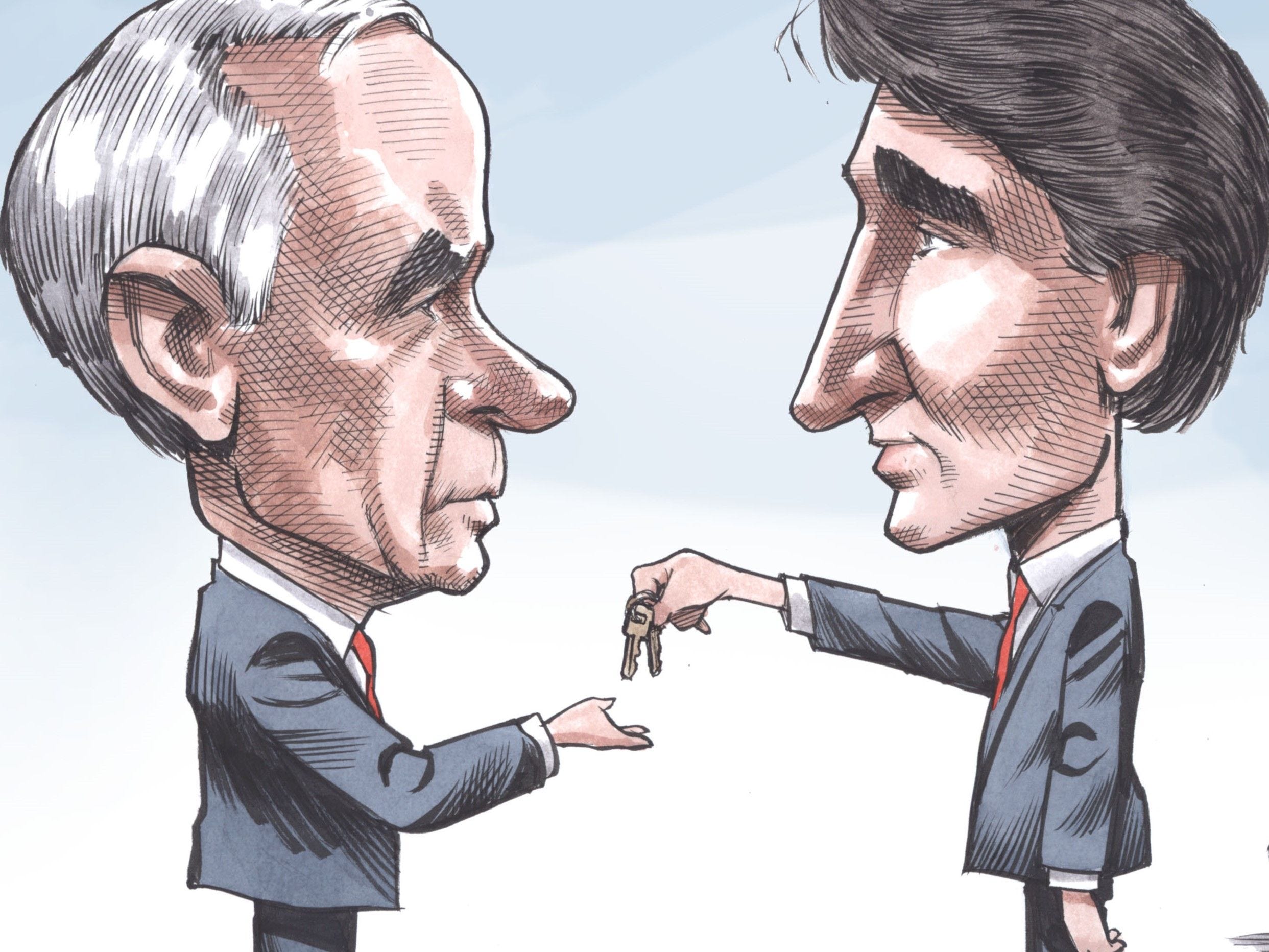
Bruce MacKinnon, The Chronicle Herald, March 13, 2025.
Who doesn’t like a good shuffle? No one!
It is the Ottawa-on-the-Rideau equivalent of "Kremlinology" - divining mountains from molehills from changing chairs at the governing grown-ups table. Breathless observers (Governance Matters included) pounce on personnel changes as harbingers of all things great, even when they might be small.

But in this case, Round II of “changes in the senior ranks of the public service” (as it is always styled) which was announced yesterday, actually is meaningful. Not by itself. But, by grafting it onto Round I and some earlier personnel changes, the governance approach of the year-old Mark Carney government is that much clearer. It has implications for the kind of governance Canadians are gonna get in the months and years ahead. And it raises questions about the performance expectations of the federal government as an institution.
Big Picture: Big Churn
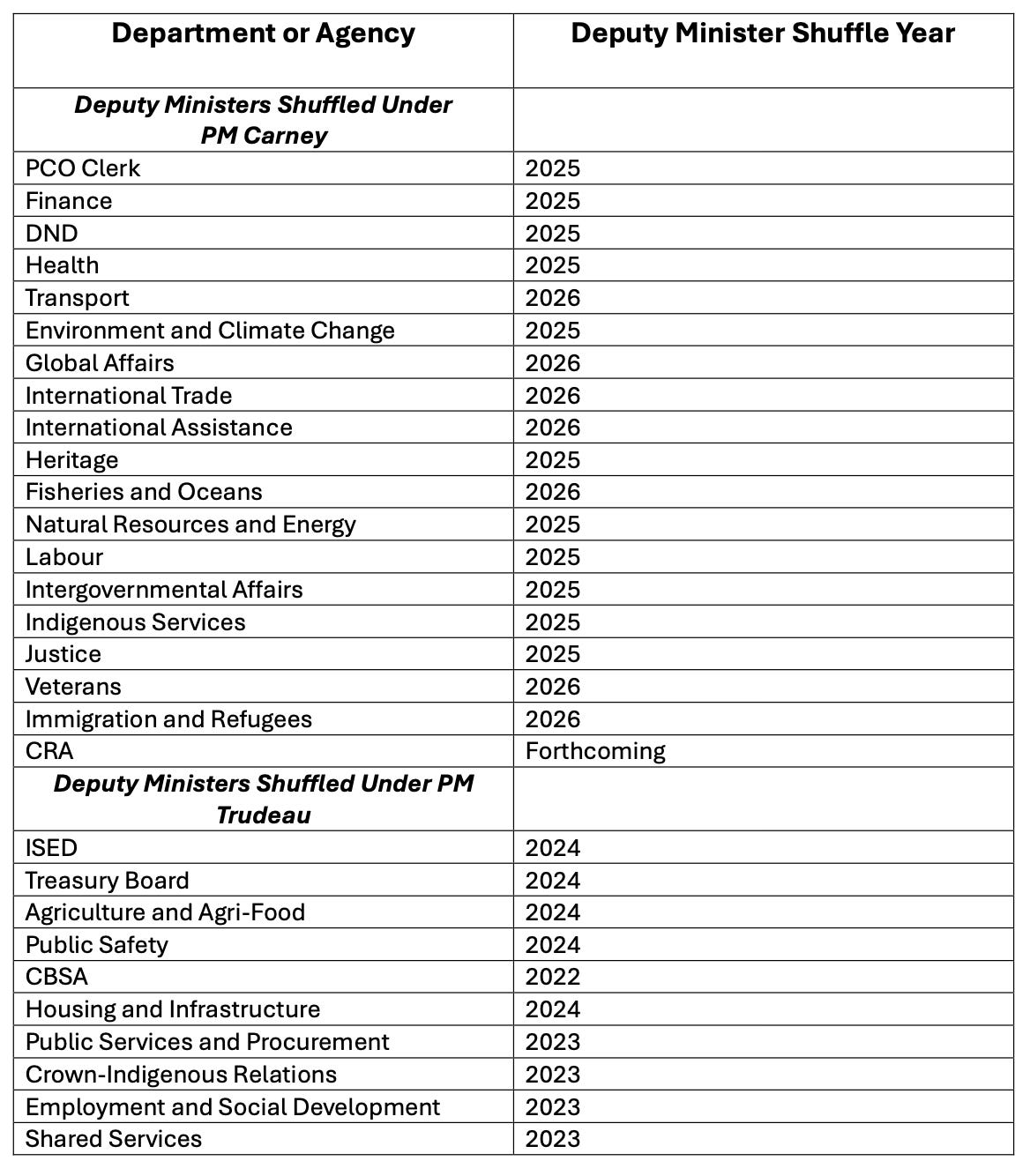
Since taking office, Prime Minister Carney and his new Clerk, Michael Sabia, have shuffled 65 per cent of deputy minister positions in the 29 most important departments and agencies. Within his own office, the Privy Council Office, it is virtually a 100 per cent shuffle in the top roles, including, of course, his own Clerk and Cabinet Secretary, his two most senior deputy clerks, and a host of deputy and assistant secretary positions.
Go back a year to when former prime minister Justin Trudeau and Clerk John Hannaford ruled the roost, and the percentage of shuffled deputy ministers rises to 86 percent. Go back to 2023, and we have a 100 percent change in deputy ministers.
That’s a lot of churn in the top executive positions of Canada’s largest enterprise, the federal government.
Here’s the DM shuffle list by year. You’ll see what I mean.
Round I vs. Round II
Shuffle Round I occurred in December. I wrote about it here as Deputy Minister Overboard. That’s because eight DMs outright left the public service, willingly or not. Shuffle Round II confirmed the departure of just three DMs, two of whom were pre-announced a few weeks back. Their retirement had come due.
Round I had a stronger, but not exclusive, focus on economic portfolios - think Finance, Natural Resources and Energy. Round II has a stronger, but also not exclusive focus, on international portfolios such as foreign affairs, trade, and international development. Kremlinology, indeed.
Combined, this is really the message of the two shuffles together - the PM has completely changed his senior domestic economic and international deputy minster cadres. Operational deputies have, for the most part, were left in place (think CBSA, Treasury Board, Public Services and Procurement, Shared Services). In doing so, Carney has deliberately sought to bulk up the most crucial departments for his agenda.
Why Change Deputy Ministers?
PMs and Clerks consider a range of factors in deciding who goes where. It’s not just knowledge or managerial skills that matter (increasingly it is managerial given the amount of churn that has occurred over the years) but human factors too - euphemistically called “fit”. Can the DM work effectively with his or her minister?
Since PM’s appoint ministers for a reason, he will want them to be paired with the most effective bureaucratic counterpart to deliver for and with them. Clerks, in their role as Cabinet Secretary, are alive to this reality. And if they’re not, ministers have been known to grumble about their deputies directly to the Clerk when seeking a change. Lobbying is always a thing in government. Is that what occurred with the Immigration and Refugees Canada deputy minister who was shuffled back to his previous position at the Canadian Food Inspection Agency, two years after being appointed to IRC? Given the rather public struggles of the minister, well-documented here, it begs the question.
I wrote this about choosing new DMs in a previous post (reprised here) that I think is still at work in the current shuffle:
Competence - do they have the knowledge and skills to run this particular organization?
Fit - can they work with their assigned minister and collaborate well with other senior officials?
Perspective - do they share the guiding zeitgeist of the government in where it wants to go and how it wants to get there?
Add in the more prosaic factors of voluntary retirements and the need to shuffle DM ranks can grow. CRA is a good example as the DM is retiring after almost 10 years as Commissioner or Stephanie Beck retiring from public service as DND DM late last year. Plus, once you move one DM for one reason, a cascade can begin requiring you to move even more to accommodate. The overwhelming need to change one or two people in key departments means you have to find jobs for the DMs they replaced - or they are ‘retired’. So, shuffles can grow … quickly.
Making Sense of It All
This level of senior officials shuffle is far more deliberate than not. It is certainly not ‘business as usual’ in official Ottawa. It is purposeful to revitalize the DM team for the new government’s agenda. To do this, the PM/Clerk undertook approaches:
New People in Old Positions - bringing in external folks to take on existing departmental or agency roles. Eg: Glenn Purves from Blackrock to International Trade.
New People in New Positions - bringing in external folks to take on new roles in new agencies. Eg. Doug Guzman for the new Defence Investment Agency or Dawn Farrell for the Major Projects Office or Ana Bailao for Build Canada Homes.
Old People in New Positions - moving an existing DM or senior official to a new entity being created. Eg. Rob Stewart moving from International Trade to helm the nascent Financial Crimes Agency.
New People in Old Positions - promoting a senior official into a DM role for an established department or agency. Eg. Nick Leswick moving from Bank of Canada to DM of Finance or Marie-Josee Hogue to DM of Justice from the Bench.
Old People in Old Positions - shuffling current DMs from one department or agency to another. Eg. Michael Vandergrift moving from NRCan to Transport.
For all the ballyhoo of recruiting private sector folks into government, it is occurring but not as extensively as perhaps imagined. Even then, for the most part, these individuals are not taking over core federal departments. See #2 above. Given the overall churn of the past few years a lot of DMs are new overall into their roles. See #4 above. Because of that Carney /Sabia are relying mostly on #5 - old people in old positions. But they are not very ‘old’ in their roles.
Here’s a reminder from November’s Budget,that the government STILL wants to recruit ‘outside-in’ where and when they can.
“There is a need to bring in talent and perspectives from outside the government into the public service at speed and scale. To this end, the government is announcing that the Interchange Canada program will be rebranded as the Build Canada Exchange, with an ambitious, immediate-term goal of integrating 50 external leaders in technology, finance, science, and other sectors into the public service.” pg. 219
The overall takeaway after two extensive shuffles is that this prime minister and clerk are not afraid of disrupting the traditional roles and responsibilities of the DM and senior officials cadre to advance their agenda. They are equally not afraid of disrupting governing structures by creating new ones to advance their agenda.
Still, it is hard not to conclude that there is a large whiff of ‘non-confidence’ in the previous/current governance system they inherited and are now piloting. Not for nothing, many outside observers and insider practitioners would concur. We do not have a fit-for-purpose governance model in our federal government for the tasks ahead.
Doubling-down on DM churn must have seemed a necessary first and second step to address this. Increasingly, though, this is now their government with their team. If we see further churn ahead, then that non-confidence whiff will grow even more unpleasant as it grows closer.
Here is the PM’s news release on the DM shuffle.
Thanks for this!
Genuine question: given the struggles of PM Carney and Minister Anand to calibrate Canada’s response to the Iran war to the requirements of international law, the UN Charter and other accepted norms, are they being adequately served by the bureaucracy at Global Affairs? To someone on the outside of the Ottawa foreign policy establishment they’ve looked feckless, a pattern that has coalesced beginning with their anodyne responses to the Israel / Hamas war despite there being a crystal clear humanitarian imperative.
Is GAC adequately tooled to give good advice to the Minister and PM on the blood-and-guts issues of a world on fire? If not, what needs to change?
Not sure about your point here, other than saying the Government (elected) may change but the government (the unelected) does not. The “Yes Minister” Humphries continue to actively run government. I truly hope it isn’t so. It is time for every single Government voted in to start reviewing government. Not with those who face the public. Get rid of those who have no meeting with the public. Those who cannot say what they actually contribute to Canadian healthcare. Why are we Canadians paying for folk who continually buy US, who allow US healthcare into provinces like LifeLab? It is time Canadians tell our provinces to promote Canadian healthcare companies.