Pickle Meets Petard.
Court ruling puts Danielle Smith in a referendum bind of her own making.

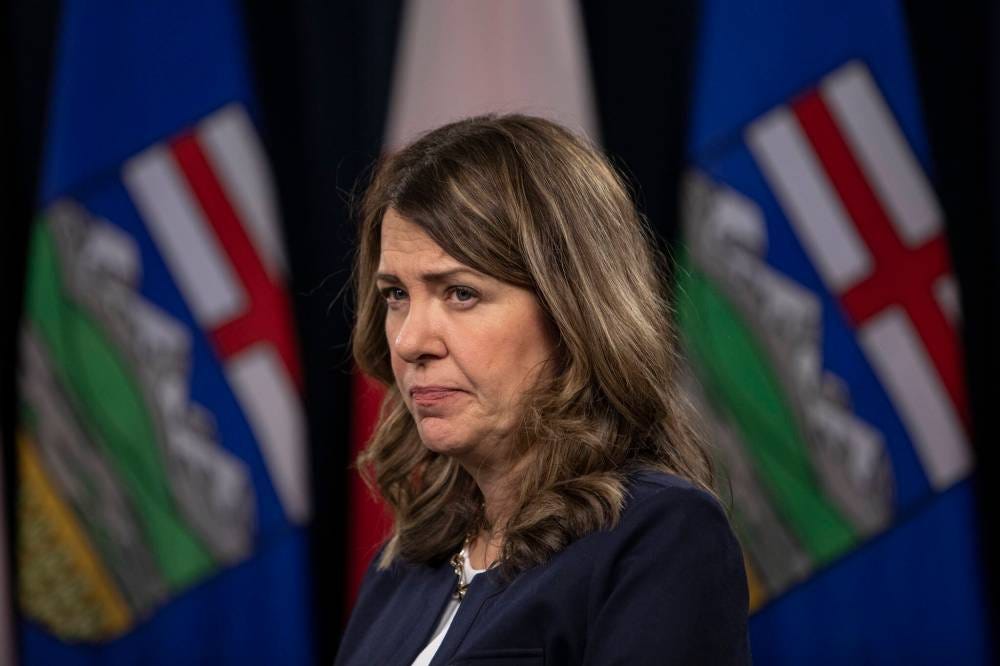
Pickle, meet petard. Alberta Premier Danielle Smith is now in a political pickle having been hoist with her sovereigntist petard.
The province’s Court of King’s Bench ruling last week that no referendum on Alberta separation can proceed without prior consultation with First Nations is a body blow to the double-game her United Conservative Party government has been playing for the past year.
At least the sovereigntist Parti Québécois is honest in their intentions. They’ve been separatists since the 1970s. Smith’s two-term UCP, which never campaigned on separation, has been trying to have it both ways. A strong Alberta in a united Canada on the one hand, a secessionist-threatening referendum on the other. Their weapon of choice: referenda. Lots of them. Nine, to be exact, to be voted on Oct. 19.
Smith’s referendums are a hodge-podge of performative policy questions that have all been written in a way to yield a yes vote. They range from more provincial control over immigration, controlling health-care access for non-citizens, and requiring proof of identity to vote (all hot-button UCP concerns) to working with willing provinces to amend the Constitution to get more provincial powers to appoint judges, abolish the Senate, opt out of federal programs and secure provincial primacy over federal laws.
They were designed to create the “perfect storm” conditions to allow for another referendum — a citizen’s petition on separating from Canada — and another yes, one she wanted to buttress Alberta’s sovereignty within Canada.
Which is why Smith’s government greased the skids for such a vote. They passed a bill to the Citizens Initiative Act that lowered the signature threshold for forcing a separation referendum, lengthened the time frame to collect signatures, and allowed for the re-submission of a previously disallowed separation petition to be considered by the chief electoral officer.
That is all in disarray now. Add to that the scandalous debacle arising from Elections Alberta’s files of personal information of millions of voters being illegally provided to a third-party pro-independence organization called the Centurion Project. Why wait for the inevitable chaos, confusion and uncertainty arising from an actual separation vote when you can have it now with the run-up to the voting process itself?
Smith did this because her UCP hosts a strong separatist contingent. An April poll by Trend Research in Alberta found only 27 per cent support for separating from Canada. But that same poll found 57 per cent of UCP voters would vote for separation.
The legal decision quashing the separatist petition puts Smith in political, not just legal, jeopardy. No wonder she announced her intention to appeal it right away, calling it “anti-democratic.” I guess it is, if you’ve been gerrymandering the democratic process all along to allow for a separation referendum.
The Court’s decision puts Indigenous rights front and centre in any separation decision. It found that allowing a separation referendum was a Crown decision in itself; hence, it “triggers a duty to consult.” Furthermore, a “yes” vote would be binding upon the government; therefore, “a requirement to implement secession without prior involvement of (First Nations) has the potential to adversely affect Treaty rights.”
The irony of all this is that the Court found that the government planted the seeds of its own legal defeat when it amended the Citizens Initiative Act late last year to allow for the chief electoral officer to green-light a previous separation petition that had initially failed to meet the legal requirements of the Act. The judgment: “Following the CEO Decision, the Amended CIA put in motion a series of required steps that engaged the duty to consult with the Applicants. No consultation occurred. Alberta breached its duty to consult with the Applicants.”
It is axiomatic that a “yes” vote would impact Treaty rights and an actual separation negotiation would require engagement with First Nations, not to mention Parliament, the federal government and all the provinces. The federal Clarity Act makes that clear. The Alberta court’s decision requires First Nations’ consultation in advance. If that stands on appeal, this embeds a big, new threshold to pass before any future separation referendum can proceed. Canadians should rejoice.
There is one, narrow way forward for Smith if she chooses to take it. Forget a citizen-led referendum; initiate a government-led referendum with a clear “yes or no” question on leaving Canada. Undertake the duty to consult in advance. Put up or shut up.
But this is a giant political risk for even this wire-pulling premier. It would require her to stake her party’s separatist colours to the public masthead for all to see. It would require a vote in the legislature which would likely split her caucus. And, in the end, it would very likely fail in an actual vote since most polls show separating from Canada as a minority opinion among Albertans.
With the Mark Carney government negotiating in good faith and making concessions on the Canada/Alberta Memorandum of Understanding, a new question arises. At what point does this performative premier stop holding Canada hostage to her own political games?
David McLaughlin is a former clerk of the executive council and cabinet secretary in the Manitoba government.
Sometimes being too clever…