COO for PMO Announced
Now do this for PCO and the public service as a whole.

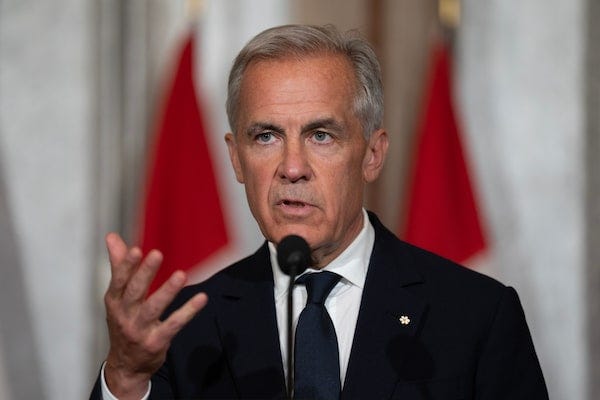
Prime Minister Mark Carney is shuffling his office. Beyond the personalities, this caught my eye. It should catch yours, if you worry about good governance.
According to the Globe and Mail, the PM is appointing a Chief Operating Officer for the PMO. The article states this:
“The sources also said that Maia Johnson, whose relationship with Mr. Carney dates back to his work on climate finance for the UN, will now take on a role called chief operating officer, in addition to remaining as a senior adviser for Canada-U.S. relations.”
Not much detail, admittedly. But this is the first such styled position with this title. It is not unusual to have, say, a Deputy Chief of Staff for Operations. Indeed, my first PMO role under Prime Minister Brian Mulroney, was called Senior Advisor, Operations. It was kind of a catch-all for files and issues that didn’t neatly fit elsewhere. In practice, I led various policy and issues management files from NAFTA to Westray, attended Cabinet and Policy and Priorities Committee of Cabinet, and (most fun) staffed the PM for all his foreign travel and a lot of domestic travel too.
But that’s not the same as being the COO for the PMO as an organization. Chief Operating Officers classically have an organizational and management remit that covers operational delivery, HR, finances, and results. Not sure if that is what Ms. Johnson will have. They are also, typically, the #2 in the organization. Although clearly senior in the PMO hierarchy, that is not obviously the case here. And, in a very Canadian quirk of styling, tis the Chief of Staff who is really the CAO or Chief Accounting Officer for the PMO per the Accountability Act.
A more efficiently run PMO is very on-brand for this particular prime minister. He should take the next - obvious - steps and apply this brand to the rest of the government he leads. Appoint a Chief Operating Officer for the Government of Canada in the Privy Council Office, reporting to the Clerk. Then, appoint a COO for each department and agency of government. Embed an operational performance focus across, throughout, up, down, and sideways in every nook and cranny of the federal public service.
It’s an idea whose time has come. I recommended this last year and the year before in two Globe and Mail opinion pieces, here and here.
“…appoint a chief operating officer with real authority for improving public service operations, productivity and performance. Make superior performance and delivering at the speed-of-need the driving ethos of what government does.”
Here’s the COO role and rationale as I spelled it out in a previous Substack article here:
I favour creating this as part of a new, designated role of Chief Operating Officer at the Deputy Clerk level. This is an equivalent peer-level position who can lean into the role with the power of the centre behind him or her. That position would be responsible for the efficient and effective delivery of government policies and programs. Make it clear that the role is distinct from, but just as important, as the policy, cabinet management, and prime ministerial support roles the Clerk plays.
That same COO role should then be replicated in each department and agency at the associate deputy minister level - a true number two. These would be the people who are responsible for service delivery and operational outcomes in ‘department-land’. Now, we have two designated positions - at the centre and throughout government - aligned and mutually responsible for better public service delivery. This is joined-up government in action.
Creating these positions would necessarily require adjusting other duplicative roles in Treasury Board. More importantly, it would require adjusting the central web of rules, reporting, and procedures that ensnares service delivery in any government. Ones that privilege reporting of effort over outcomes and results. High time this was done anyway, but creating COOs would drive these adjustments in a more productive way.
It would do so because of the forced visibility it would engender. There would finally be a clear link between responsibility and accountability for operational delivery where it matters, at the departmental and agency levels. And it would prove a useful tool to clearing away the extensive thicket of superfluous ADMs and special roles that have built up over time. It could lead to a rationalization of executive responsibilities in departments and agencies smoothing decision-making processes and clarifying ‘who does what’ everywhere.
COOs would have aligned performance agreements to motivate and measure their work. They would systematically - i.e. every day - come to the office thinking about how to improve government performance for citizens and taxpayers. COOs would inevitably become regular features at parliamentary committees to then explain their work aiding in the scrutiny function of the executive. All to the good. Attention means results in government.
Creating a COO position recognizes the demands of daily life for deputy ministers and the Clerk. Deputy ministers’ accountability is incredibly complex, fielding demands by PMO and ministers’ offices, central agencies, parliament, and compliance commissioners of all types. They are regularly pulled away into extended interactions with the prime minister and ministers or PMO or PCO on the issue of the moment. They cannot always devote time and attention to the detailed diligence of program and service delivery. This frees them from this obligation but ensures it still gets done.
If operational delivery is important to government, then it must be someone’s full time job or, experience dictates, it does not get done. It can’t be a ‘side of the desk’ focus for busy deputy ministers. Plus, it would be a useful, ongoing reminder to ministers and their staff that good policy ideas need to be supported by equally good service delivery. This would enhance ministerial accountability on the way by.
There is a COO for the UK Cabinet Office and a Permanent Secretary and COO for the Civil Service as a whole, here.
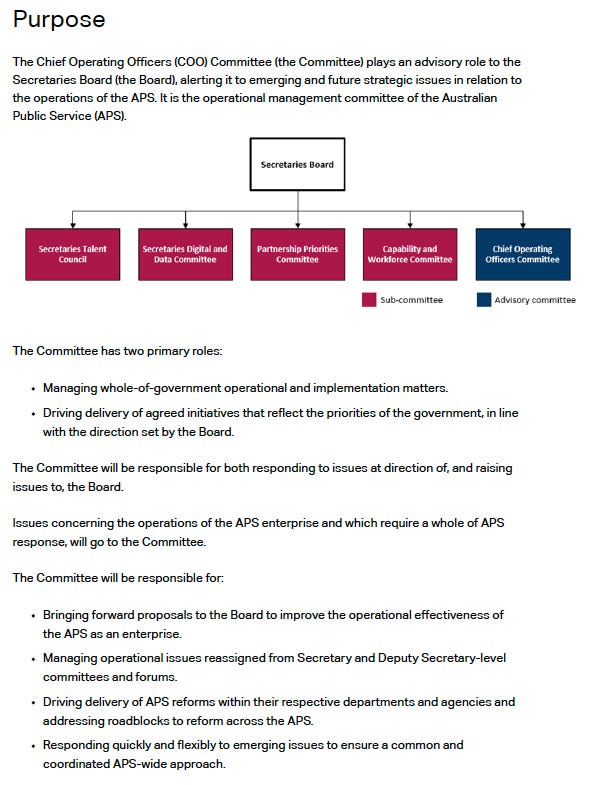
But Australia is the most complete example. There are chief operating officers across the system (for the most part). Their role and importance is institutionalized within the public service as you can see in this figure below:
Three Steps to Better Government
Time for Canada to crack on in three easy steps:
Step 1 - appoint a PMO COO.
Step 2 - appoint a PCO COO.
Step 3 - appoint GOC COOs.

Can a COO really break the IT silo issue for service delivery? The failed and still-failing mega-projects specifically for service delivery are all broken at the program business owner/IT’s client model, with the demand for huge long budgets and gigantic specifications and finger-pointing between them. In a world of AI coding, all of these are now obsolete nonsense.
Delivery is essential. Ideally, the COO will have a voice in policy development to ensure that capacity and other delivery related considerations are taken into account early.